

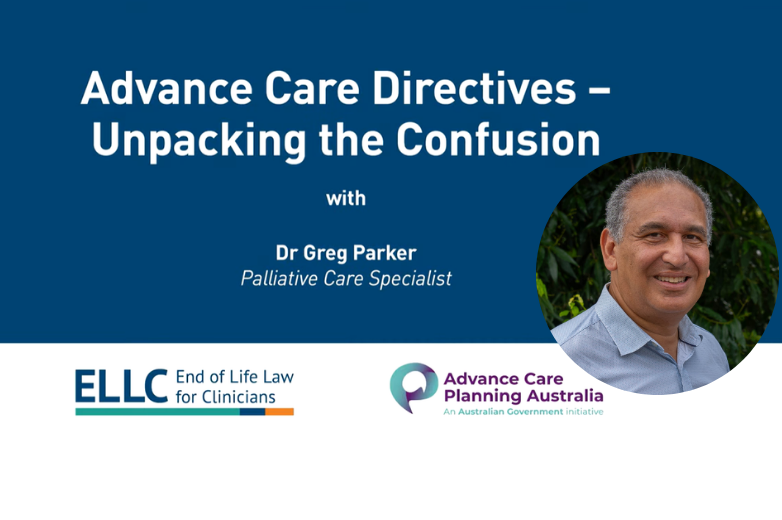
Advance care planning is a cornerstone of high-quality, person-centred care. Yet for many clinicians, uncertainty about the legal effect of advance care directives (ACDs) and other advance care planning documents, combined with the challenges of starting sensitive conversations, can make planning feel complex.
To support the health and aged care workforce, Advance Care Planning Australia and End of Life Law for Clinicians have developed two short, practical videos addressing these challenges.
In the first video, I explore one of the most common areas of confusion in clinical practice: what parts of an advance care directive are legally binding, and what this means for decision-making.
An ACD allows a person to document instructions, values and preferences for future care. A person can also use their ACD to refuse medical treatment. Importantly, refusals of treatment are legally binding and must be followed by clinicians, except in some rare situations. Other aspects, such as values and preferences, are not legally binding but remain essential in guiding decisions that align with what matters most to the person.
Understanding these distinctions is critical. It helps clinicians provide care that is both lawful and consistent with a person’s wishes.
The second video, presented by social worker Peggy Yeomans, focuses on the human side of advance care planning: how to start and continue meaningful conversations.
Advance care planning is not a single conversation, nor is it limited to end-of-life care. It is an ongoing process, one that should be guided by the person’s readiness, values and life context.
Simple approaches can make a significant difference. Normalising the conversation, using open-ended questions, and taking a trauma-informed approach can help build trust and create space for people to express what matters to them.
“This collaboration reflects our shared commitment to equipping clinicians with practical, legally informed resources that improve both communication and decision-making in advance care planning,” said Distinguished Professor Ben White, Lead of the End of Life Law for Clinicians at the Australian Centre for Health Law Research, Queensland University of Technology .
Ultimately, advance care planning ensures people retain a voice in their care, even if they are unable to speak for themselves in the future.
By strengthening both legal understanding and communication skills, we can improve the quality of care delivered across health and aged care settings.
I encourage you to watch the videos and explore the resources available through Advance Care Planning Australia and End of Life Law for Clinicians.
For additional free online training and practical legal resources to support your clinical practice, visit End of Life Law for Clinicians.